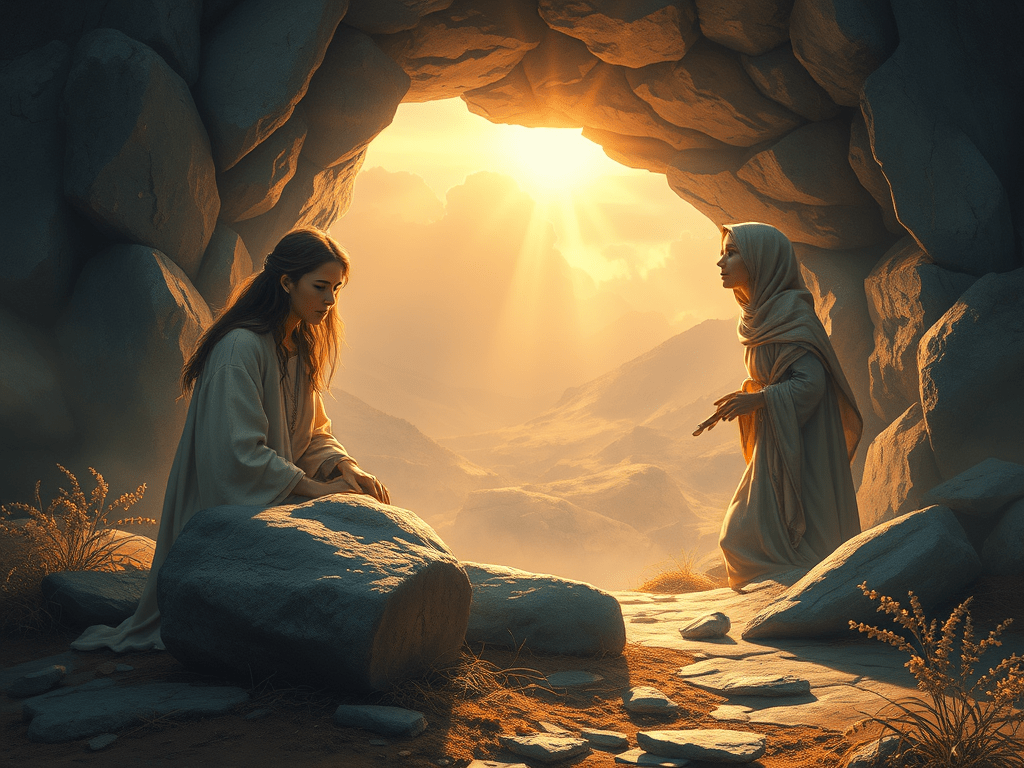
Scripture: Luke 24:1-12 (CEB)
Very early in the morning on the first day of the week, the women went to the tomb, bringing the fragrant spices they had prepared. 2 They found the stone rolled away from the tomb, 3 but when they went in, they didn’t find the body of the Lord Jesus. 4 They didn’t know what to make of this. Suddenly, two men were standing beside them in gleaming bright clothing. 5 The women were frightened and bowed their faces toward the ground, but the men said to them, “Why do you look for the living among the dead? 6 He isn’t here, but has been raised. Remember what he told you while he was still in Galilee, 7 that the Human One must be handed over to sinners, be crucified, and on the third day rise again.” 8 Then they remembered his words. 9 When they returned from the tomb, they reported all these things to the eleven and all the others. 10 It was Mary Magdalene, Joanna, Mary the mother of James, and the other women with them who told these things to the apostles. 11 Their words struck the apostles as nonsense, and they didn’t believe the women. 12 But Peter ran to the tomb. When he bent over to look inside, he saw only the linen cloth. Then he returned home, wondering what had happened.
The Word of God for the People of God
Thanks be to God!
Why?
I have to confess to all of you here today that I am not a morning person. My alarm went off at 4:30, and it was by an act of divine power alone that I am standing here in front of you now. May God be praised, and may I be granted an IV line of coffee for the rest of this day.
What got you up this morning? What brought you out of bed, and out to the steps of Trinity United Methodist Church, at this hour? You might or might not be a morning person, but surely there must’ve been a choice, a moment of decision, that brought you here. What were you looking for? Who were you hoping to find? Why come out today, set up a chair, and join others to reflect on The One who died, and then rose again?
Our passage for today is part of the story of the first Easter, and in our passage, though many famous Bible characters appear, one figure is curiously absent. Jesus’ tomb is empty, and because of this, his followers are confused and unsettled. In the modern Church, we too are confused and unsettled, and as the original disciples struggled to understand what the disappearance of Jesus’ body meant for them, we too are struggling to understand our place in his story. Today, most of the efforts to resolve this question seem to emphasize one thing: in Christ’s story, we are the main characters. His story is about us, and we are free to define him on our own terms, according to what makes us most comfortable, because divine love should be made to fit human expectations. All across the world, and across the spectrum of theological possibilities, we have pictured Christ in our image. Safe, yes. But is that enough? Is that who you were looking for when you got up this morning? Or were you looking for something more?
In 1988, James Tillman was arrested for a series of violent crimes, and sentenced to 45 years in prison. Inside, he was exposed to all the violence and fear, all the hardship and difficulty, all the loneliness and alienation that comes with being treated as a violent criminal in America. And the whole time, he was innocent. In 2007, DNA evidence conclusively exonerated James Tillman of his supposed crimes. Which meant that Tillman spent almost twenty years behind bars for nothing. Twenty years of lost wages from his job at a car wash. Twenty years of not eating dinner with his mom. Twenty years of living life, suffering, in a broken world that, in its own way, had made a cross just for him.
And though it is not mentioned, in our passage for today, the Cross continues to loom large. We have been taught to see the Cross as an instrument of salvation and redemption, but that was not why the Romans and Judaean rulers procured it. They wanted a symbol of dread and an instrument of death. They wanted to eliminate a spiritual and political dissident and preserve the unholy alliance of religious dogmatism and imperial power they had created. And for them, the Cross was resoundingly successful. It wasn’t just that Jesus was killed. It was that what he represented was killed, publicly and violently. Uplift for the poor. Redemption for the supposedly unclean. Forgiveness for the sinful. Hope. These things died with Christ too.
Today, anywhere eyes are downcast, anywhere joy is absent, anywhere people have been reduced to mere survival without the possibility of hope, there we will find the crucified. The crucified walk our streets and fill our homes. They are attending funerals, and sitting in prisons. They are sheltering under bridges, and hiding from tanks and planes. They are crossing the Rio Grande, and digging into the soil in a West Virginia holler. They are sitting in comfortable homes, lamenting the reality that money cannot buy love. They are perched in hospital beds, receiving diagnoses from doctors with grim faces. And they are swinging the whip, slashing with the sword, squeezing the trigger, because if you have lost so much hope that the only way you can connect with the world around you is by causing others pain, you have truly found yourself in a place of death. Good and bad, all suffer. And all carry their cross.
Today, though, things are different. Today, the tomb is empty, and the Cross is vacant. Today, in a place once consumed by darkness, angelic beings gleam brightly. Today, James Tillman walks free, and if we wish to, we can join him. “Why do you look for the living among the dead?” the angels ask. Why do we look for the living among the dead? Why do we want Christ to be like us, when he is so much more? What if we stepped back, and saw Christ as he truly is? Christ is not our idealized self, and Christ is not comfortable or easy. Christ is God made flesh, divinity and humanity, coming together. Christ is the revelation of God’s truth, and the inauguration of God’s reign. Christ is the proclamation of God’s justice, and the declaration of God’s mercy. Christ is the realization of God’s power, and the offer of God’s healing. And today, as the sounds of life sing all around us, and the darkness of night gives way to the rising sun, Christ is the one who casts death aside like discarded grave clothes, and comes out of the tomb to end our crucifixion, and lead us forward into new life.
You might or might not be a morning person. And you might or might not have come here looking for something. But whatever brought you here this morning, may you leave richer than you came. Life’s challenges are real. And all around us, people are in pain. But today, Christ reminds us that this pain is not the ending of our story, because our stories are a part of his story, and his story does not end in death. Today, we have been invited to answer this one simple question: do you want to have hope again? Because what is Easter, if not proof that in the end, the God of hope wins? So have hope. Walk free. Leave suffering behind. And give thanks, that death is defeated, and Christ the Lord is risen today. Hallelujah. Praise God. Amen.

 Gladness and Hunger
Leave a comment