Paul, President Carter, and the Logic of Grace
10 In Damascus there was a disciple named Ananias. The Lord called to him in a vision, “Ananias!”
“Yes, Lord,” he answered.
11 The Lord told him, “Go to the house of Judas on Straight Street and ask for a man from Tarsus named Saul, for he is praying. 12 In a vision he has seen a man named Ananias come and place his hands on him to restore his sight.”
13 “Lord,” Ananias answered, “I have heard many reports about this man and all the harm he has done to your holy people in Jerusalem. 14 And he has come here with authority from the chief priests to arrest all who call on your name.”
15 But the Lord said to Ananias, “Go! This man is my chosen instrument to proclaim my name to the Gentiles and their kings and to the people of Israel. 16 I will show him how much he must suffer for my name.”
Acts 9:10-19
The 1970s were not a good time to be an American.
Vietnam had come and gone, and left behind the sting of military frustration, moral outrage, and generational trauma. Oil embargos paralyzed much of the economy. Nixon’s Watergate Scandal eroded confidence in the functionality of American democracy. The churn of civil conflict over basic issues of human rights and dignity continued. And in the midst of all of this, a good man stood up in front of his country, and tried to remind Americans of a better way.
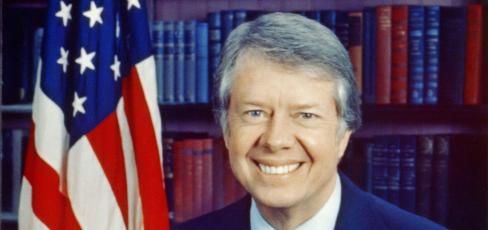
On July 15, 1979, President Jimmy Carter went on television and addressed the nation. I first became aware of this address in 2003, watching the movie Miracle in theaters with my dad and brother. The movie, which tells the story of the 1980 US Olympic Men’s Hockey Team, treats this speech as a framing device, a data point that helps to explain the significance of that team’s Olympic experience. But to me, the words of this speech have lingered as a profoundly moving piece of oratory in their own right. Here’s just a sample:
The erosion of our confidence in the future is threatening to destroy the social and the political fabric of America.
The confidence that we have always had as a people is not simply some romantic dream or a proverb in a dusty book that we read just on the Fourth of July.
It is the idea which founded our nation and has guided our development as a people. Confidence in the future has supported everything else — public institutions and private enterprise, our own families, and the very Constitution of the United States. Confidence has defined our course and has served as a link between generations. We’ve always believed in something called progress. We’ve always had a faith that the days of our children would be better than our own.
Our people are losing that faith…
President Carter passed away on December 29, 2024. And yet, now as much as ever, Carter’s words from 1979 seem to ring true. We are losing faith in the American experiment, and we are losing faith in each other. Our national discourse is heavy on criticism, but low on efforts to find consensus or solutions. We celebrate when figures from our camp humiliate figures from another. We relish the opportunity to blame someone else for national problems. And we actually believe that bad behavior from politicians and personalities from our own side are somehow justified if we can point out parallel examples of bad behavior from the other side. As if the preschool defense of “Well he started it” should apply to debates over national policy which impacts the lives of billions of people the world over.
What has happened to us?
The word “Faith” appears eight times in President Carter’s speech from 1979, and I have to believe that is not a coincidence. A lifelong Christian and, famously, devoted Sunday School teacher at Maranatha Baptist Church, Carter was a man of deep inner piety, a man who vivified that piety through his actions in the world, including his presidency. For many of us, there is a clear line between the sacred and the secular, an area in which the commands of faith end and the realpolitik concerns of the world begin. Surely, anyone who can make decisions over whether or not to use nuclear weapons has to have some cynicism to them. And yet Carter seems to have understood two things about the place of faith in public life that we have forgotten today. The first is that, for a Christian, faith must guide every decision we make, including decisions about public policy. The second is that the duty of the Church in the public sphere is not primarily to tell others what they can and cannot do, but to show them what the Church is willing to do for them.
In its early days, there was little the Church could do in public life. The Roman Empire was not a democratic polity, and the Church was small, powerless, and persecuted. Chief amongst those persecutors was a man named Saul, a man who is said to have murdered several amongst the Church. And yet, Saul, a man schooled deeply in the traditions of Judaean religion, would come to play a key role not in the destruction of Christianity, but its spread. While on the road to the city of Damascus, Saul experienced a moment of conversion, in which, in a vision, Jesus Christ appeared to him, called him to account for his violence, and blinded him before sending him on his way. Saul arrived in Damascus, and it was there that he came under the care of a man named Ananias, who helped him to regain his sight, and–under the new and now famous name Paul–take his place as a key figure in the early Christian movement.
The stirring thing about that transformation, though, is how reluctant Ananias is to be involved in it. While living his life in Damascus, Ananias is greeted with a vision from God. In this vision, God instructs Ananias to go to Saul and give him his sight back. Ananias, though, is hesitant. He knows Saul’s bloody history, and he wants nothing to do with the man. His reaction is understandable. It is, after all, how we feel about those who we believe are dangerous.
God’s response, though, has no patience for such restraint. “Go!” God commands. “This man is my chosen instrument to proclaim my name to the Gentiles and their kings and to the people of Israel. I will show him how much he must suffer for my name.” After all that has happened, it is God’s will that a man who has murdered Christians will become the one who spreads Christianity throughout the world. And his suffering will not necessarily be an earned fruit of his past sins. Rather the text’s inclusion of the phrase “For my name” suggests that something deeper is afoot. Paul suffered and struggled tremendously in his career as an evangelist and apostle. Is this his righteous punishment, or an inevitable consequence of trying to spread the message of Jesus Christ to a world hostile to his teachings? Either way, we can say this much: dispensing retribution is not part of Ananias’ God-assigned task. Whether Ananias likes it or not, God has decreed that Paul will play a key role in God’s plans going forward. Ananias must get over his own hesitations and grievances against Paul, if he too wants to be in those plans.
The logic of retribution is popular in our world. We love to collect a list of wrongs from others, and assess punishments for those wrongs. Rightly or wrongly, we do this for each other, and we do this for ourselves. The logic of grace is comparatively uncommon. Speaking in my capacity as a United Methodist, I would tell you that the logic of grace begins with the claim that people are created good. Genesis 1 tells us as much, repeatedly and insistently. Furthermore, we are not just good, we are created in God’s image, bound to our creator in a special relationship. All the world’s evil is not an inevitable consequence of what it means to be human, but a deviation from God’s original plans. The logic of grace decrees that restoration is possible. That the evil that rests in human hearts is more a sickness than a fundamental fact of the human condition. And the logic of grace promises that, with the right “medicine,” evil can be diminished, defeated, and dethroned in each of our hearts. We will not be perfect, but by God’s grace and love, we can live together again, cooperatively, peaceably, and harmoniously, because we ourselves are different from who we used to be.
The time has come to reclaim the logic of grace. We need to believe that the power of God’s grace, the grace that transformed Saul into Paul, is sufficient to transform our people too. We need to embrace that, as God chastised Ananias–and not Saul the murderer–so we too must be chastised for refusing to deal with our foes in a spirit of grace. To be sure, you might be convinced beyond the shadow of a doubt that your take on current issues is the right one. And there is no doubt that we have a duty to name injustice, and bring human suffering to an end. But if we do this outside of the logic of grace, according to God, our efforts will count for nothing. We should not wish to crush our foes, but to transform them. And, we should embrace the fact that, the task of a disciple is to follow God in reconciling us to each other, washing the evil out of our hearts, and teaching us to finally live peaceably together.
This is God’s goal for all the world, and for each of us. Perhaps we could start with trying to live this way in America.
In the 1980 presidential election, President Carter was soundly defeated. Ronald Reagan, the governor of California, carried almost every state in the electoral college, and won almost ten percent more of the popular vote than Carter did. Reagan assumed the presidency, while Carter left behind a presidency that has been roundly denounced as a failure by historians and commentators. And yet over the last 45 years, Carter has emerged in our collective memory as a beacon, a reminder that decency, kindness, and hope can occupy a prominent place in national and world affairs. Carter spent the years after his presidency advocating for peace in various conflict zones around the world, participated in hurricane relief efforts, helped found the non profit housing provider Habitat for Humanity, and founded The Carter Center and The New Baptist Covenant–organizations dedicated to advocating for human rights and social justice, respectively. In 2002, 22 years after leaving public office, Jimmy Carter won the Nobel Peace prize. People might have given up on Jimmy Carter as president, but as a man, Jimmy Carter never gave up on people. And his memory lives on as an inspiration to what we can accomplish when we choose to be people of love, and embody the logic of grace in every aspect of our lives.
In 1979, this was all in the future. But reading his July 15 speech, it’s hard not to see the man who would one day offer so much to so many. Quoting a Camp David visitor, Carter told the nation this:
We’ve got to stop crying and start sweating, stop talking and start walking, stop cursing and start praying. The strength we need will not come from the White House, but from every house in America.
His words still ring true. It’s time to get to work. It’s time to believe in the power of grace, and to live our lives as if, by our help, those whom God created good might be good, once again.
This will be a challenge. It will run counter to the spirit of the times. And it will cause us to face discomfort from those who profit from our continued division and estrangement. It’s worth it to pay this price, but make no mistake, there will be a price to pay.
Is there any hope? Is there any chance that our efforts to share grace will be successful?
What would Jimmy have to say?
With God’s help and for the sake of our nation, it is time for us to join hands in America.
Working together with our common faith we cannot fail.
God is good. God is with us. Be brave. And trust that, in the end, God’s grace will triumph.

 Gladness and Hunger
Leave a comment