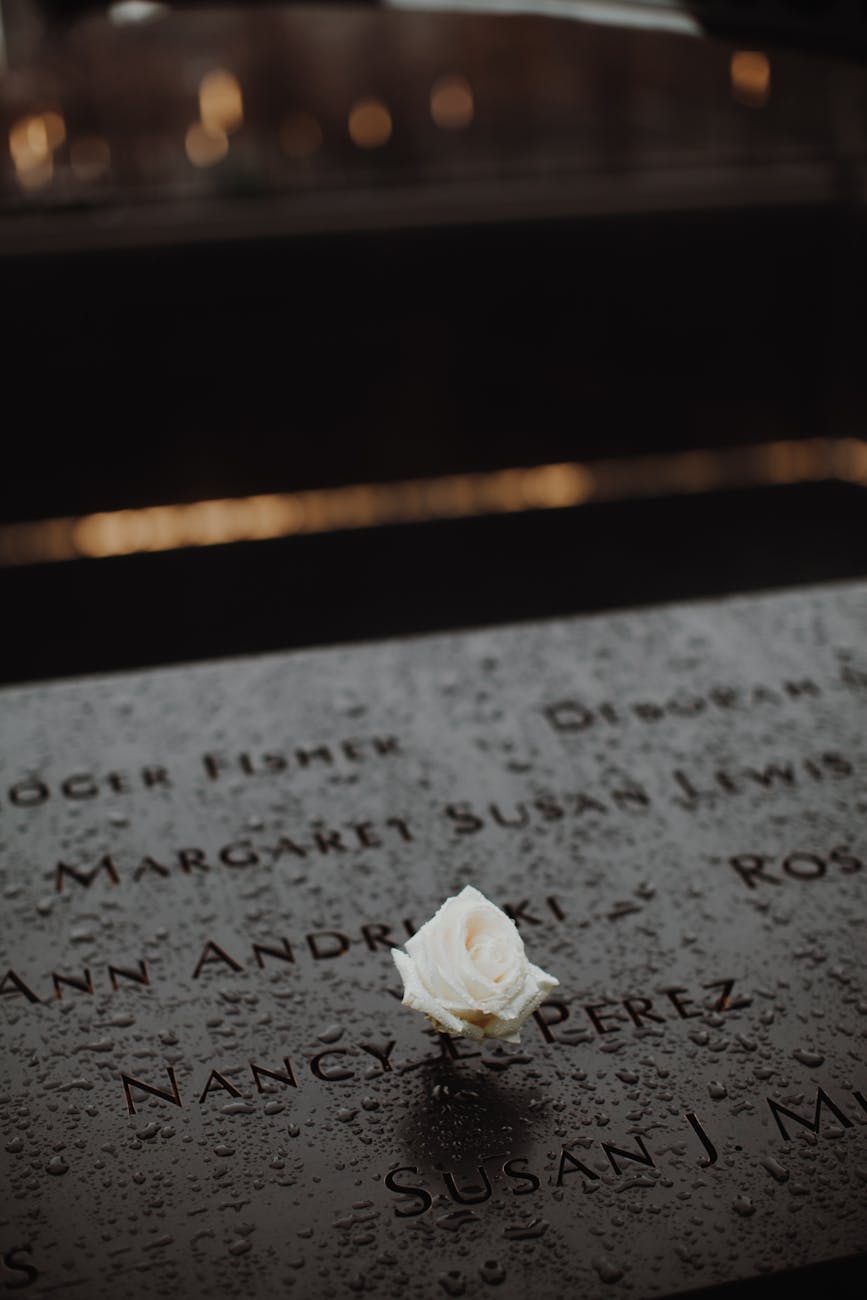
Please be advised that this post relates to the events of September 11, 2001, which was a hard day for many people, and to the experience of violence more generally. The words herein are offered, not in a spirit of condemnation, but in a spirit of love, to be a guiding light to those of us who want to make the world a better place.
“Are you ready? Okay. Let’s roll.” – United Flight 93 Passenger. September 11, 2001.
The hand of the Lord was on me, and he brought me out by the Spirit of the Lord and set me in the middle of a valley; it was full of bones. 2 He led me back and forth among them, and I saw a great many bones on the floor of the valley, bones that were very dry. 3 He asked me, “Son of man, can these bones live?”
I said, “Sovereign Lord, you alone know.”
4 Then he said to me, “Prophesy to these bones and say to them, ‘Dry bones, hear the word of the Lord! 5 This is what the Sovereign Lord says to these bones: I will make breath enter you, and you will come to life. 6 I will attach tendons to you and make flesh come upon you and cover you with skin; I will put breath in you, and you will come to life. Then you will know that I am the Lord.’”
7 So I prophesied as I was commanded. And as I was prophesying, there was a noise, a rattling sound, and the bones came together, bone to bone. 8 I looked, and tendons and flesh appeared on them and skin covered them, but there was no breath in them.
9 Then he said to me, “Prophesy to the breath; prophesy, son of man, and say to it, ‘This is what the Sovereign Lord says: Come, breath, from the four winds and breathe into these slain, that they may live.’” 10 So I prophesied as he commanded me, and breath entered them; they came to life and stood up on their feet—a vast army.
11 Then he said to me: “Son of man, these bones are the people of Israel. They say, ‘Our bones are dried up and our hope is gone; we are cut off.’ 12 Therefore prophesy and say to them: ‘This is what the Sovereign Lord says: My people, I am going to open your graves and bring you up from them; I will bring you back to the land of Israel. 13 Then you, my people, will know that I am the Lord, when I open your graves and bring you up from them. 14 I will put my Spirit in you and you will live, and I will settle you in your own land. Then you will know that I the Lord have spoken, and I have done it, declares the Lord.’”
–Ezekiel 37:1-14
Tuesday, September 11th 2001 was a beautiful day in Arlington Virginia. I was in the second grade, sitting with my classmates listening to my teacher at Campbell Elementary School, when an announcement came on the loudspeaker overhead instructing students and teachers to prepare for an early dismissal. At that moment, my dad came through the door of our classroom, my little brother in tow, to take me home. As we walked out of the classroom, onto the playground, and towards our Ford Explorer, I asked my dad what was happening. Twenty three years later, I can still hear the heaviness in his voice as he responded by saying “Our country is under attack right now, Daniel.”
There are many indelible images I have of that day. One of them came just a few minutes later, when we pulled into the parking lot at a gas station near our house, and began to fuel up. We didn’t know exactly what was happening, but my dad wanted us to be prepared, in case, for some reason, we needed to leave town. As we were putting gas in the car, an F-16 fighter jet came flying overhead. As a child, I was very interested in military aviation, and had seen the Air Force’s demonstration team, “The Thunderbirds,” perform great feats of aerial acrobatics at numerous air shows, all while flying F-16s. This aircraft and its pilot, though, had no time for acrobatics. The aircraft roared past us in a straight line, at what I can only describe as “Shoot to kill” speed. That pilot, whoever they were, was on a mission. A real mission. And I was not a spectator to that mission, as I might have been if I were watching that plane on TV, or in a documentary. I was a part of it, an objective in the Air Force’s broader mission to protect the homeland.
Today, I associate that memory with a loss of innocence, and my first real exposure to the random cruelty of human affairs. At the time, though, I didn’t have the words to explain its deeper meaning, I just knew that I was scared. There are other memories I have of that day, and memories like that and worse are common for many of the people I grew up with in Northern Virginia, a community that revolves around the Federal Government, including the Pentagon. I would imagine that plenty of people from New York, Pennsylvania, and the surrounding areas have similar memories. And my experience pales in comparison to those of the people who suffered permanent physical and psychological injury that day, and especially to those who, all across the country, lost someone that day. In the years since, much has been said about the heroism displayed that day, by firefighters and policemen, by soldiers, sailors, marines, and airmen, and by everyday people. Americans owe it to each other to remember the pain as well.
What has troubled me increasingly over the last twenty three years is how uncommon this act of remembering has become. As America’s internal politics and international standing have changed, 9-11 has migrated from a shared traumatic experience to an event discussed by history textbooks, commercialized by America’s Patriotism-Industrial Complex, and fought over in America’s ongoing culture wars. And watching all this, I have found myself increasingly struggling to connect to the way the story of September 11, 2001 is told today. Of course, there are reasons for this shift. Suppressing grief and trauma is a natural coping mechanism, and human empathy, like human nature, has limits. But even so, the oft-quoted aphorism “Those who forget the past are doomed to repeat it” holds true. By treating the events of that day as “History” and consigning them to carefully constructed narratives in textbooks, documentaries, and newscasts, we neglect the chaotic, overwhelming messy fear and grief that comes with living through human events in real time. We remove humanity from history. And in the process, we declare through our actions that tragedies from which we are separated by space and time count for less than those which we experience personally.
The Book of Ezekiel has a distinctive quality in the canon of Judeo-Christian scripture. Where many of the other prophets in the Bible rely solely on words to express God’s will, Ezekiel frequently harnesses the power of imagery, building metaphors for the text’s reading audience that are equal parts evocative, challenging, and creepy. In the passage above, we enter a scene built around such a metaphor. The prophet stands in a valley of dried bones, bones that, according to God, belong to the people of Israel. The power of the metaphor rests in its connection to actual events from Israelite history. In 722 BCE, the ancient Near-Eastern superpower Assyria destroyed Israel’s northern Kingdom, and sent its people into exile, an experience from which they would never return. In 587, another regional power, Babylon, did the same to Israel’s southern Kingdom. Against all odds, though, the people of the southern Kingdom, held together, and preserved their own cultural heritage and understanding of God, an effort which helped produce the Book of Ezekiel. Ezekiel speaks not just to us today, but to the people of the sixth century Israelite community. Ezekiel’s valley of dry bones refers to something real, not a real place, but certainly a real experience, an experience shared by a generation of people steeped in memories of bloodshed, destruction, and national collapse.
But in our passage, this valley of dried bones does not stay as such. We look on, as God commands Ezekiel to prophesy first to the bones of fallen Israel, and then to the breath, the life force, which, at his command, washes through these bones and reanimates the slain. God restores Israel, not by replacing those who have been lost, but by restoring the lost to life. Israel is not recreated, but revived, and its people are brought back from death to return to their homes, and to the land they called their own. What once was lost has now been found. And the valley of dry bones is empty, because the dead are dead no more.
This is how God acts in human history. The God who would leave the 99 behind to find the one lost sheep (Luke 15:1-7) is a God who meets each of us as individuals, and the God who died on a cross as the victim of injustice and oppression, all while shouting “My God my God, why have you forsaken me?” (Matthew 27:46) has claimed made our grief, trauma, and fear as spaces for divine presence. Even as human life, and human history, move on, God remembers. And even as we leave the valley of dry bones behind, God remembers that each of those bones belonged to people with families, hopes, and dreams. God remembers and re-members the lost. And in doing so, God helps us to anticipate the promise of resurrection.
There is a measure of truth to the saying that “Time heals all wounds.” Certainly, moving forward is necessary. God has not created us to be chained irrevocably to the past. But equally, we must remember that there is a difference between moving forward and moving on. We might be content to walk past the Valley of Dried Bones without sparing a glance, but it is there that we can find God at work. As we consider the events of Tuesday, September 11, 2001, and the countless other tragedies–both large and small–of human history, it is an inevitable reality of our human nature that we will allow these memories to fade gently out of our shared consciousness, and into the pages of history. But in a world that is so quick to forget the cost of human life, forcing ourselves to treat distant tragedies with humanity, and to not to forget the lost, is an act of faith. After all, as the Apostle’s Creed reminds us, we are called to believe “In the resurrection of the body” and to recognize that, when God’s Kingdom comes, we will join that kingdom alongside the people whose dry bones once filled Ezekiels’ desolate valley. May we remember. And may we give thanks that “In life, in death, in life beyond death, God is with us, we are not alone, thanks be to God. Amen.”1

 Gladness and Hunger
Leave a comment