Trouble in Paradise
For three of my four college summers, I worked as a camp counselor at a small Christian camp an hour away from my parents’ house. And I loved pretty much everything about it. I loved the environment–being outside in nature, watching the sun set, feeling the cool morning air, and learning about the bugs and lizards that surrounded us. I loved the work–walking everywhere, building fires, digging in the dirt. And, of course, I loved the kids. The younger ones used me as a human jungle gym, the older ones as a big brother figure who was never “cool” but was at least “fun.”
I had a tougher time with my fellow counselors. To be clear, I still love these people. Many of them taught me how to be a Christian as I came into adulthood. By their words and their deeds, they helped me to follow Jesus. But there were many ways in which we differed in our understanding of what that meant. We were all very young, and still learning how we fit into the world. Our conversations–conducted on beautiful summer evenings surrounded by boundless evidence of the beauty of God’s creation–were not always easy.
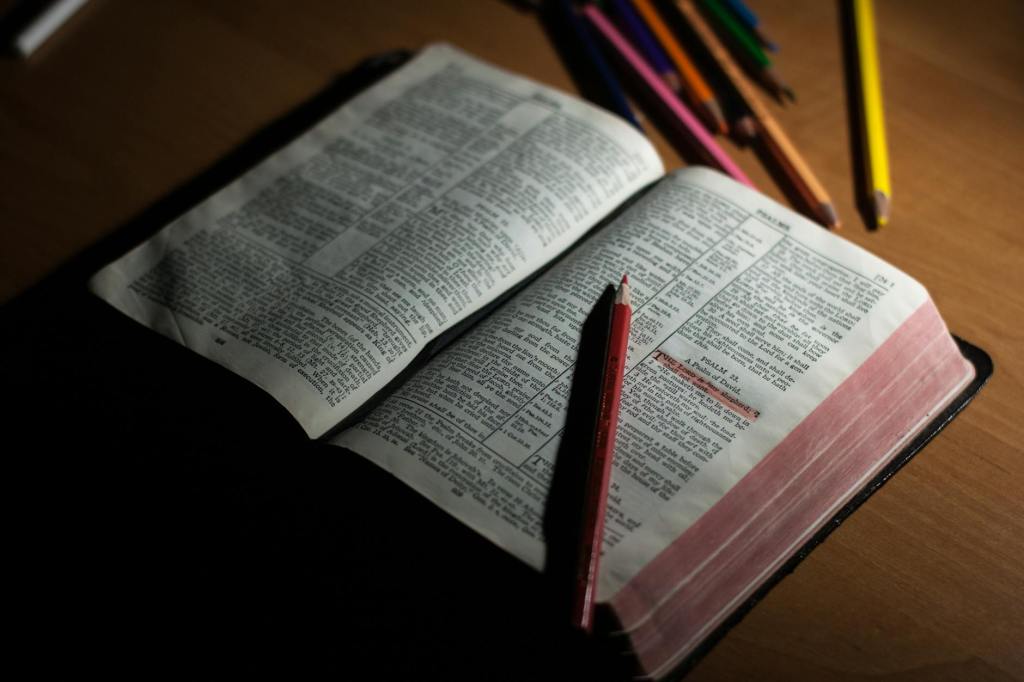
We were especially far apart, it turns out, when it came to the Bible. We all saw the Bible as Holy Scripture, as a key piece of how God reveals God’s self to humanity and instructs us in our lives. But we had very different understandings of how scripture is holy. I saw the Bible as a book containing truth but also subject to humanity’s imperfection and requiring interpretation. I did not know it yet, but I was much closer to the United Methodist view “That Scripture is the primary [emphasis mine] source and criterion for Christian doctrine.”[1] Many of my fellow counselors disagreed. They would have preferred the statement of the Southern Baptist Convention (SBC) which describes the Bible as, “A perfect treasure of divine instruction. It has God for its author, salvation for its end, and truth, without any mixture of error, for its matter.”[2] In the SBC view, the Bible is holy because its content comes directly and exclusively from God, and therefore whatever the reader finds in it is entirely self-sufficient as a statement of Christian truth. In the United Methodist view, it is impossible to ignore the role of the human hand in the construction of the Bible, and thus to choose between personal sensibilities and the apparent meaning of scripture in clashes over the nature of science, history, morality, human nature, and the character of God.
What makes the Bible holy? Answering this question is essential in our efforts to believe well. To do so, we need to consider what the Bible is.
And what the Bible is not.
Turkish Delights
On the southeastern edge of the Bosporus Strait, there was once a city called Chalcedon. Founded by colonists from the ancient Greek city of Megara, Chalcedon was a vibrant trading center, until the city to its northwest–named first Byzantium, then Constantinople, then Istanbul–gradually swallowed it up. Today, old Chalcedon is within the city limits of Istanbul, but there is still a “Metropolitan of Chalcedon” within the Greek Orthodox Church, which may be a nod to the old city’s incredible importance for Christian history.
In 451 CE, as the Roman Empire was collapsing in western Europe, the Emperor of the Roman east, a man named Marcian, called for a council of church bishops and leaders to meet in Chalcedon. The purpose of this council was to determine whether Jesus was divine, human, or, somehow, both. Similar disputes had been raging in Christian circles almost since the first written records of Jesus’ life had emerged several hundred years earlier. Numerous Church figures had suffered legal and professional consequences for answering this question in a way that the official church determined was wrong. Some had even suffered violence. Now, the Emperor Marcian hoped to resolve this question once and for all.
The Council of Chalcedon accomplished this goal by offering an inspired theological insight. In a document called the “Chalcedonian Definition” or the “Chalcedonian Creed,” the Bishops who attended this council stated together that Jesus was “Complete in Godhead and complete in manhood, truly God and truly man.”[3] Simultaneously, the Chalcedonian Definition also stated that, in Jesus, humanity and divinity had come “Together to form one person and subsistence, not as parted or separated into two persons, but one and the same Son and Only-begotten God the Word, Lord Jesus Christ.”[4] Jesus might have had two ‘natures,’ but he was one ‘person,’ in which both natures were fused together.
If this dispute feels like academics debating how many angels can fit on the head of a pin, consider the consequences of rejecting the statement Chalcedon produced. Every December 25th, most Christians celebrate the birth of Jesus, in whose presence we find Emmanuel, God with us. The joy and hope of Christmas stem from this one reality–that in the midst of the darkness of winter, and of our lives, God is here. Paradoxically, however, God comes to us in the form of a baby, weak and helpless. Suddenly, the creator of the universe has become familiar, vulnerable, and relatable. The events of Holy Week similarly point us toward this paradox. On Good Friday, when Jesus hangs from the cross and calls out “My God, my God, why have you forsaken me?”[5] he expresses a sentiment common to us humans. Because Jesus is fully divine and fully human, he becomes the means through which the divine experiences human alienation from God. And in so doing, God reconnects with us, and makes our moments of doubt holy. A few days later, on Easter, we get to rise with Jesus, and to experience resurrection with him, because Jesus rises from death in the same human flesh that was crucified days earlier. These ideas fall apart, if the Council of Chalcedon is not their foundation.
The Chalcedonian position has been treated as truth by just about every major denomination of Christianity for almost 1500 years. But why did it take so long to emerge? By 451, the four Gospels found in every Christian Bible today had been in existence for over 300 years, had been included together in a common book for almost 70, and Christian commentators and thinkers had argued for their primacy as the definitive accounting of Jesus’ life since at least 170 CE.[6] If the people of the Church had access to the same set of Gospel texts, and yet it took the Church decades or even centuries of disputation to see Jesus as one person, fully divine and fully human, the texts themselves must not clearly and unambiguously point toward the Chalcedonian position. Arriving at this position–foundational as it is to the Christian understanding of Jesus of Nazareth–was a feat of interpretation. And, as anyone who has ever been wound into an anxious knot by a text message or email can understand, interpreting anything is innately subjective, personal, context-dependent work.
The Bible is beautiful. The Bible is the primary source of Christian doctrine. But we need other tools–the Christian tradition, our faculties of reason, and individual and communal experience–to buttress the Bible as we use it to try and understand who God is. Both the Council of Chalcedon, and the events that made this council necessary, suggest that the words of scripture, by themselves, cannot be God’s complete and perfect self-disclosure to humanity. For me, the Bible is Holy Scripture. But understanding what this means today requires digging beneath the most obvious readings of scripture, and into the paydirt beneath.
The Word of God
On January 2, 2018, while on a vacation with my family, I got into a bad skiing accident. The left wing of my pelvis – doctors call it the iliac crest – was fractured, and most of the nerves in and around my left quadricep were damaged. According to my orthopedist, this accident was so serious that I very nearly could have bled to death. I spent ten days in a hospital, most of them in the ICU, went through four surgeries, and, eventually, six months of physical therapy. In the meantime, I moved back into my childhood home with my parents for three months and began to address the emotional challenges of this accident. My parents were great. My friends were great. But recovering was not easy.
One night, while I was still living with my parents, this accident produced something of an epiphany. I was getting into bed. Injured as I was, this was an involved process which required me to carefully sit down perpendicular to the bed and use my hands to rotate myself ninety degrees, while hoisting my left leg onto an elevated pad that kept the pressure off my wounded left side. Once all this was done, I eased my torso back into the bed, and let my mind wander. I had just one semester of seminary left, and at that moment, my friends were back in Atlanta, finishing their degrees, while I remained at home. I was desperately eager to get back and get into the work of ministry. It was fitting, then, that my thoughts turned to Jesus. What would Jesus say to me at this moment?
The answer came to me quickly. Jesus would probably say something like “I understand,” because he too had been through extreme physical distress. Scripture tells us that, on the day Jesus was condemned by the Sanhedrin and by Pilate, he was flogged, beaten, humiliated, and rejected by his followers, before being crucified.[7] To be absolutely clear, I was not abandoned by my friends and family during my recovery. In fact, my experience was the opposite. And my accident was the result of a mistake I made while undertaking a recreational activity, not a multitude of human injustices. But as I lay in bed and considered the simple fact of Jesus’ physical and emotional distress, I felt that I had a companion. I knew these details about Jesus because of the Bible, a book that brought Jesus into my life, 2,000 years after his resurrection and ascension.
For Christians, the Bible is primarily the story of Jesus, God made flesh. In Genesis, God creates humanity, and humanity rejects its creator. So God forms a covenant with a man named Abram, later renamed Abraham, that will eventually lead to the healing of the whole world.[8] Because of this covenant, God rescues the Israelites–Abraham’s descendants–from enslavement in Egypt, gives them land to settle, recounted in Deuteronomy and Joshua, and commands them to love their neighbors as themselves, in Leviticus.[9] When the Israelites reject God again, God keeps coming back to them, first through kings like David, and then through prophets like Elijah, Jeremiah, Ezekiel, and others.[10] Finally, when the Israelites are crushed, and the survivors of Abraham’s descendants become dominated by overlords–first the Babylonians, then the Persians, then the Seleucids, then the Romans, God re-enters the picture personally, through Jesus.
And in doing so, God not only honors God’s commitments to Abraham’s descendants, but expands the reach of those commitments to all the world. By dying and rising, Jesus defeats death, and repairs the rift between humanity and divinity. The Book of Acts and the New Testament letters describe the efforts of people trying to make sense of these events on behalf of the faithful, efforts which are still ongoing today, and which will find their conclusion in the final harmonizing of heaven and earth described in the Book of Revelation.[11]
Intermingled within this larger story that Scripture describes are several smaller stories. And many of these smaller stories seem to challenge the coherence of that larger narrative. Many people have correctly pointed out that the Bible often contradicts itself, describing divine commitments to peace, justice, mercy, inclusivity, and compassion, as well as a story of genocide and mass murder,[12] sexual violence,[13] ethnic, gender, and religious prejudice,[14] and child sacrifice,[15] much of which is undertaken by God, or in God’s name. The Bible is a deeply human book that came into being thanks to an unknown number of different writers, editors, and storytellers, working at different times and in different places, across a span of, at minimum, several hundred years.
Does this make the Bible somehow less true? Or does it make the Bible true in a different way? The Bible does not just tell a story. The Bible also reflects our humanity back to us. We too are all a mess of contradictions, trying to balance our best moments with our worst impulses, our deepest morals with our darkest desires, and our greatest hopes with our deepest fears. We can see these contradictions in the Bible, a book that tells terrible stories for disquietingly relatable reasons. The Book of Joshua is the story of Israel’s genocidal triumph over the people living in their ‘promised land,’ a triumph orchestrated by a powerful God and a massive Israelite army. This story was probably written by the Israelites after the Babylonian army had destroyed their kingdom, slaughtered their countrymen, evicted them from their homes, and forcibly deported them back to Babylon. Which means that, as much as we condemn its authors, we must also empathize with them. These people were not the first to let grief drive them to hatred, and they would not be the last. The Bible helps us to understand this about ourselves: that we too are capable of great evil. The Bible is a mirror, and through its messiness, we come to see our own. Simultaneously, the Bible never shies away from proclaiming God as the main character in the human story. The Bible’s best moments and it’s worst are bound together by a shared consciousness that, however fickle and inconsistent we might be, God remains with us. Even in our worst, most Joshua-like moments, God keeps showing up.
Finally, the Bible is not just a story and a mirror, but a means of communication. In many Christian denominations, it is common practice that when the Bible is read aloud during worship, the reader finishes the passage and then says, “The Word of God for the People of God,” and the congregation responds by saying, “Thanks be to God.” In the Gospel of John, the Gospel writer states that “The Word became flesh and made his dwelling among us.”[16] This statement refers to Jesus. To speak of the Word of God, then, is to speak of Jesus, the one who triumphed over death on Easter, and declared to his disciples that he would be “With you always, to the very end of the age.”[17] It is for this reason, I believe, that slaves in the United States were able to find, in the pages of Bibles given to them by their enslavers, divine declarations of their dignity; why the holy scripture of Christopher Columbus and Hernan Cortez inspired Latin American liberation movements in the 20th century; and why the story of Jesus Christ could bring comfort to me, as I tried to keep the pressure off my pelvic bone while I lay down in my childhood bedroom, trying to go to sleep. Jesus is alive and is with us today. And the Bible, the Word of God, is the means by which Jesus speaks to us now, comforting us and accepting us as we are, while also holding a mirror up to us so that we might more fully participate in the story God is still writing for humanity.[18]
So much more can, and should, be said about the Bible. It is impossible to offer the final word on a living document, and I have not even begun to address the many controversies in which the Bible has been embroiled. But if the Bible is the Word of God, and if God remains alive and with us, then the Bible will continue to enjoy a place of primacy in our efforts to believe well. We will struggle to understand Scripture without the Christian Tradition, our faculties of reason, and our experiences of God. But as our understanding of Scripture deepens, so too does our understanding of the other three sources. The Bible is the means by which God draws us all into a common experience. Without the Bible, there is no Christianity. With the Bible, we can see that Jesus is alive, is present with us in our lives, and is with us in our suffering. May we give thanks for the Word of God, for the story it tells, and for our place within that story as the beloved children of the God of the universe.
[1] “Theological Guidelines: Scripture.” The United Methodist Church. Accessed June 10, 2024. https://www.umc.org/en/content/theological-guidelines-scripture.
[2] “Baptist Faith and Message 2000: The Scriptures.” The Southern Baptist Convention. Accessed June 10, 2024. https://bfm.sbc.net/bfm2000/#i.
[3] “The Chalcedonian Creed” The Westminster Standard. Accessed June 10, 2024. https://thewestminsterstandard.org/the-chalcedonian-creed/
[4] Ibid.
[5] Matthew 27:46 (All Translations NIV). Also Mark 15:34.
[6] “The Emergence of the Four-Gospel Canon,” Elaine Pagels, L. Michael White, Elizabeth Clarke, Harold Attridge, and Allen D. Callahan. The Public Broadcasting Service. Accessed June 14, 2024. https://www.pbs.org/wgbh/pages/frontline/shows/religion/story/emergence.html.
[7] Matthew 26 and 27, among others.
[8] Genesis 12:3.
[9] Leviticus 19:18.
[10] See 1 and 2 Samuel, 1 and 2 Kings, and all of the Prophetic books.
[11] Revelation 21:1-7..
[12] For example, Joshua and the Noah story.
[13] For example, the rape of the Levite’s Concubine in Judges and the rape metaphors that predominate in Ezekiel.
[14] Again, Joshua. Also, Revelation, and the story of Jesus with the Canaanite.
[15] The binding of Isaac story in Genesis, and the story of the Exodus.
[16] John 1:14.
[17] Matthew 28:20.
[18] Much of my thinking on this topic comes from a pair of books I read in seminary. See Mariano Magrassi, Praying the Bible, An Introduction to Lectio Divina, trans. Edward Hagman, OFM CAP (Collegeville, MN: Liturgical Press, 1998). See also Karl Barth, Dogmatics in Outline (New York, NY: Harper Perennial, 1959).

 Gladness and Hunger
Leave a comment